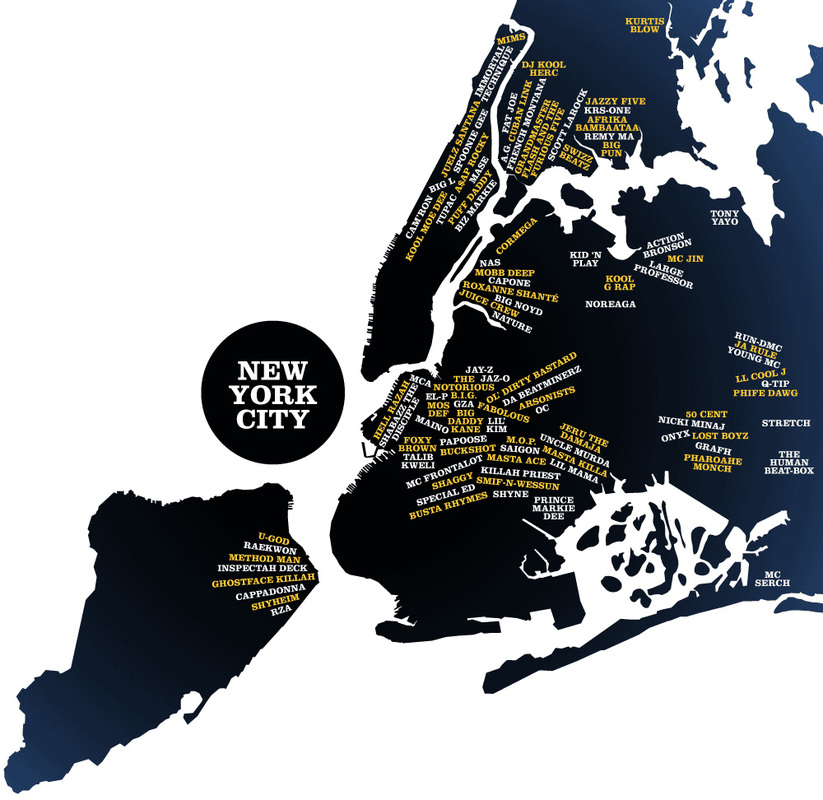
 Rap Map created by website www.rapgenius.com The "rap map" helps teachers and students to map out the residences of hip-hop/ rappers that have come out of the New York City area. This is not a complete map of all hip-hop artist from NYC, but it is a great start. Maybe you and your students can make a map that represents your city and state's development of hip-hop...
If you want to learn more about the terrain of hip-hop you should take a moment to create a list of hip-hop artist from your area and plot them out on a map of your area. Post and share with us, and we will give you credit. The Rap Map, created by rap lyric explanation website Rap Genius. Please check out www.upout.com for a full article about the rap map. Also check out www.genius.com and www.pastemagazine.com for other supports in learning more about hip-hop's terrain. Thanks go out to contributing music/musicking educator Cynthia Macias for sharing this info!
3 Comments
We would like to thank Jamie Ehrenfeld, Fresh Ed & Urban Arts Partnerships - NYC for the sharing of their documents to hep further our understanding of Culturally Responsive Pedagogies and how they can be enacted in musicking classrooms all over the world. Fresh Ed is a standards-based curriculum that acknowledges and capitalizes on young peoples’ fanatical love of pop music rhythms, and retrofits its culturally responsive signiers (style) to reframe the way content is presented. In other words, Fresh Ed uses hip-hop music and youth culture to make ELA and social studies content accessible to middle school students who otherwise might nd it foreign or irrelevant. Its culturally responsive design is specfically informed by the ideas presented in “A Framework for Culturally Responsive Teaching” (Raymond J. Wlodkowski and Margery B. Ginsberg)..... Getting to know and understanding your students is at the root of culturally responsive pedagogy (CRP). Fresh Ed posits that learning cannot take place unless we know our students. Before exploring academic content, it is necessary to create a classroom culture that enhances social emotional learning (SEL). These activities are broken up into three categories: The Three Class Commandments, Ice Breakers and Team Builders. Because they are intended to build community, relationships, and understanding between students and educators, they should be used heavily at the start of the program, as well as implemented throughout the process..... READ THE ATTACHED DOCUMENT FOR FURTHER DETAILS ON HOW TO ENACT THIS IN YOUR MUSICKING CLASSROOM...
Here is some student feedback on the lesson:
“Learning hip-hop was a lot of fun! Hip-hop is such a large part of youth culture and putting it into an educational lesson really opened my eyes to the fundamentals that you don't really pay attention to when you hear the songs on the radio. Not only were we able to learn and create music, but we learned about the roots of hip hop as well, which I believe allowed the students to enjoy the richness of the genre a little more! The only thing I wish was different about this small unit was to have some more time and listen to what everyone had come up with.” “I had never really given much thought to hip-hop music . . . However, I was immensely intrigued by the history of it, and by the end of the brief presentation I had a mild admiration for the genre based upon its varied sources/ roots. I found that after learning about its origins, it wasn't simply a repetitive rhythm with words but an ancient art, slightly modernized. The improv section was amazingly fun, not only because it allowed me to explore completely new ideas but because I got to try and apply what I had just learned . . . After experiencing the presentation and improv I have a respect and understanding of [hip-hop's] roots and overall have a favorable opinion of it.” Lesson plans can serve as a starting point of exploration into Hip Hop, Technology, Critical Pedagogy, and Literacy in hopes of creating an engaging, exploratory, musical classroom. Just like Hip Hop, take what you like, explore and create what you need with what tools you have, and make something new. These lesson are not to be executed identically, but tailored to your needs.
The following comes from Adam Kruse's (2016) article, "Featherless Dinosaurs and the Hip-Hop Simulacrum: Reconsidering Hip-Hop's Appropriateness for the Music Classroom" in Music Educators Journal.
Examples of “Clean” Hip-Hop Songs (over 30 years) “Clean” is in the ears of the listener. Teachers should listen ahead before using these in class. Many of the artists listed below have numerous “clean” songs. 1986 – “It’s Tricky” by Run-DMC 1987 – “I Know You Got Soul” by Eric B. and Rakim 1988 – “Lyte as a Rock” by MC Lyte 1989 – “You Must Learn” by Boogie Down Productions 1990 – “Can I Kick It?” by A Tribe Called Quest 1991 – “Summertime” by DJ Jazzy Jeff & The Fresh Prince 1992 – “Jump” by Kris Kross 1993 – “Keep Ya Head Up” by 2Pac 1994 – “We Run Things (It’s Like Dat)” by Da Bush Babees 1995 – “I Wish” by Skee-Lo 1996 – “Earth People” by Dr. Octagon 1997 – “Just Cruisin’” by Will Smith 1998 – “Everything is Everything” by Lauryn Hill 1999 – “Hip Hop” by Mos Def (Yasiin Bey) 2000 – “When Kenpo Strikes” by RedCloud 2001 – “Held Down” by De La Soul featuring Cee-Lo 2002 – “It’s Going Down” by Blackalicious 2003 – “I Can” by Nas 2004 – “Breathe, Stretch, Shake” by Ma$e featuring P. Diddy 2005 – “Birds Eye View” by Zion I 2006 – “Kick, Push” by Lupe Fiasco 2007 – “Paper Planes” by M.I.A. 2008 – “Lip Gloss” by Lil Mama 2009 – “Creepin’” by Chamillionaire featuring Ludacris 2010 – “Window Seat” by Erykah Badu 2011 – “Beautiful” by Talib Kweli featuring Big K.R.I.T., Outasight & Mela Machinko 2012 – “Good Feeling” by Flo Rida 2013 – “I’m Turnt” by Lecrae 2014 – “Glory” by Common & John Legend 2015 – “Sunday Candy” by Donnie Trumpet & The Social Experiment The following comes from Adam Kruse's (2016) article, "Featherless Dinosaurs and the Hip-Hop Simulacrum: Reconsidering Hip-Hop's Appropriateness for the Music Classroom" in Music Educators Journal.
Examples of Conscious Hip-Hop Musicians (from A to Z) Akala Boog Brown Common Dead Prez Eyedea FM Supreme Gift of Gab Heems Immortal Technique Jean Grae KRS-One Lupe Fiasco Mr. Lif Nas One Be Lo Public Enemy Q-Tip Ruby Ibarra Salome MC Talib Kweli UGeorge Vinnie Paz Wise Intelligent X Clan Yani Zion I The following comes from Adam Kruse's (2016) article, "Featherless Dinosaurs and the Hip-Hop Simulacrum: Reconsidering Hip-Hop's Appropriateness for the Music Classroom" in Music Educators Journal.
Starting Points for Hip-Hop Classroom Experiences Hip-Hop as a Bridge (connecting hip-hop to other music and vice versa)
Hip-Hop as a Lens (hip-hop as a way to understand contexts)
Hip-Hop as Practice (hip-hop as hip-hop musicians do it)
|

